
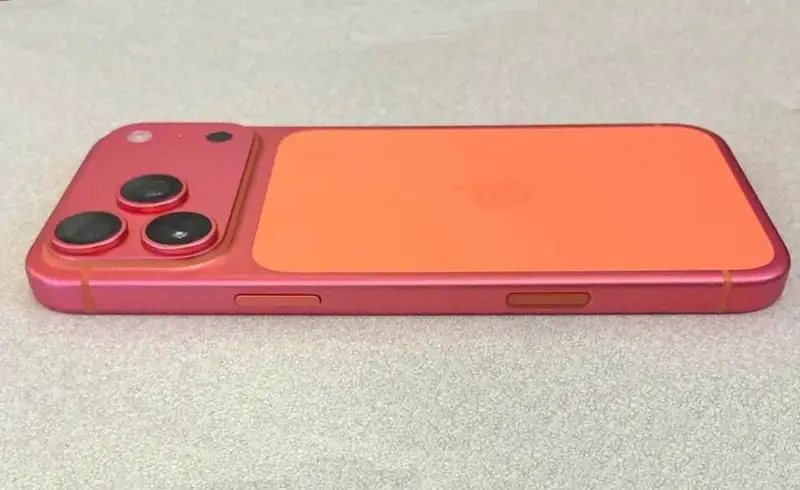
Media timeline — how Colorgate exploded
The story didn\'t appear suddenly — it built step by step over 9 months. Here are the key moments that turned a single Reddit post into an international phenomenon with 47 million views on TikTok alone.
Reddit user DakAttack316 posts the first viral thread: „Update on orange iPhone 17 Pro Max that turned pink" with before/after photos after 3 weeks of normal use. Within 24h, the thread passes 12,000 upvotes.
Sammy Fans picks up the story with the title „Apple's latest innovation: Orange iPhone 17 Pro turning Pink". The snowball effect starts on Asian tech channels.
MacRumors publishes main coverage with user recommendations — avoid direct UV exposure, verify cleaning wipes. Update to article confirms multiple cases.
AppleInsider: „Cosmic Orange iPhone 17 Pro's color-changing is probably not the owner's fault" — initial chemical analysis pointing to organic dye + incomplete sealing as prime suspects.
TikTok explodes with „color reveal" videos — users post tests with hydrogen peroxide + antibacterial wipes generating discoloration in minutes. Hashtag #colorgate gathers 47M views.
In parallel — Scratchgate emerges: durability tests on GSMArena, JerryRigEverything, iFixit demonstrate that anodization on the camera bump chips off („spalling") on sharp edges. More visible on Deep Blue and Cosmic Orange.
9to5Mac publishes independent testing: most units do NOT develop the phenomenon under normal use. Conclusion: the problem exists but affects a limited percentage of units, correlated with specific environmental factors.
iFixit publishes detailed teardown with microscope: „ScratchGate: Blame Apple, Not The Aluminum". Structural cause identified — sharp corners on camera bump instead of gradual chamfer.
Apple partially responds via Tom's Guide: „Worn MagSafe risers to blame for material transfer" — acknowledges material transfer from worn MagSafe risers to iPhone back but does not comment on general discoloration.
The topic remains at the top of Apple Community, r/iphone, MacRumors Forums discussions. No official replacement program, no recall, no publicly documented process change. The second-hand market starts differentiating prices.
Chemistry anatomy — why this happens
To understand Colorgate, you need to understand how aluminum anodization works. Apple uses the standard industrial process called „Type II" (decorative anodizing) for all iPhones in recent years. The comparison below clearly shows where the inherent trade-offs of this choice are.
| Parameter | Type II (decorative) | Type III (hardcoat) | What Apple uses |
|---|---|---|---|
| Oxide layer thickness | 5-25 μm — thin layer, suited for decorative finish | 25-100 μm — thick layer, hard-coat for industrial applications | Type II — thickness in 8-15 μm range based on iFixit teardown data |
| Surface hardness | ~200-400 HV (Vickers) — hard, but not stainless-steel level | 60-70 HRC (Rockwell C) — harder than a pocket knife blade | Type II hardness — vulnerable to sharp corners and concentrated abrasion |
| Process temperature | 18-22°C, moderate voltages (12-24V), standard sulfuric electrolyte | 0-5°C (actively cooled), high voltages (24-90V), concentrated sulfuric electrolyte | Classic Type II — lower cost, allows wide palette of vibrant colors |
| Color options | Wide palette — organic dyes (red, orange, yellow, green) + inorganic (bronze, black) | Limited palette — darker, industrial colors (black, gray, military green). Less uniform results on vivid colors | Organic orange dye — vibrant color, but the most fragile against UV and chemicals |
| Typical applications | Consumer goods — phones, laptops, utensils, sports equipment | Aerospace, medical equipment, heavy-duty tools, military applications | Type II fits a premium smartphone as aesthetic finish — expected trade-off |
| Sealing (final closure) | Mandatory — immersion in hot water/nickel acetate solution to close pores and lock dye into structure | Optional — functional hard-coat maintains properties even without complete sealing | This seems to be the weak point — incomplete sealing leaves pores semi-open, allowing chemical absorption |
Technical conclusion: Apple chose Type II anodizing with organic dye for Cosmic Orange — combination that offers vibrant color (nearly impossible to obtain with Type III or inorganic dye), but with major durability compromises. Silver uses inorganic dye which is chemically stable — that\'s why it doesn\'t have Colorgate. The choice of Cosmic Orange is an aesthetic choice with a hidden durability price.
The 5 factors that trigger discoloration
Not all iPhone 17 Pro Cosmic Orange units develop Colorgate — even 9to5Mac demonstrated that most users don\'t observe the phenomenon. The difference — exposure to one or more of these 5 identified factors. The more you accumulate, the exponentially higher the probability.
Hydrogen peroxide (H₂O₂)
Direct UV radiation (sun, tanning sessions)
Sweat + lactic acid + salts (prolonged skin contact)
Prolonged heat (heat cycling)
Worn MagSafe risers (material transfer)
Scratchgate — why anodization chips off the camera bump
Colorgate doesn\'t come alone. Scratchgate — the spalling phenomenon of anodizing on sharp edges — was documented in parallel by iFixit with complete teardowns. The roots are structural, not chemical: camera bump design with right angles instead of gradual chamfered edge.
Camera bump — sharp corners
Spalling phenomenon
Differential vulnerability per color
MagSafe circle
How to verify at home if you have real phenomenon
Before panicking or investing in premium cases, verify objectively if your unit is susceptible. 4 simple tests you can do at home with cheap materials — total under $5.
Distilled water control test
Hydrogen peroxide 3% test (hidden area)
Portable UV lamp test
Visual comparison covered vs exposed area
What Apple says officially vs unofficially
Apple\'s Colorgate communication has been inconsistent — nothing public on apple.com, partial acknowledgment in 1-on-1 support, one single semi-official position via Tom\'s Guide in May 2026 about MagSafe risers. Here\'s the complete situation:
| Context | What Apple says | What\'s missing |
|---|---|---|
| Official communication on apple.com | Nothing. The „iPhone 17 Pro cleaning" page does not mention Colorgate, does not acknowledge the phenomenon, does not offer specific recommendations for orange anodized aluminum. | Public acknowledgment + cosmetic warranty program + clear usage guide |
| Support 1-on-1 (chat / call) | Support acknowledges the phenomenon in private conversations with affected users. Recommends avoiding peroxide-based products and direct UV exposure. | No standard compensation, no free replacement — case-by-case evaluation |
| Retail (Apple Store) | Genius Bar performs visual inspection, may offer replacement within warranty IF they evaluate the case as „manufacturing defect" (rare). Generally — no. | Clear written policy — decision depends on specific Genius |
| Semi-official position (via Tom's Guide, May 2026) | Apple acknowledges that worn MagSafe risers can cause „material transfer" — advises periodic replacement of holders | Does not explain remaining cases (users without MagSafe who still have discoloration) |
| AppleCare+ (insured units) | Colorgate is NOT covered. Physical-cosmetic wear is explicitly excluded in T&C. Scratches can be covered on replacement with $129/$199 deductible. | Colorgate remains on your own — even with AppleCare+ |
How to prevent realistically — 5 practical measures
If you already have iPhone 17 Pro Cosmic Orange (or Deep Blue) and want to avoid Colorgate/Scratchgate, here\'s the practical plan. No extreme measures needed — 5 simple habits reduce risk by ~90%.
Case always — and the right one
Not any case protects the surface. Transparent cases with UV-blocking treatment are the most effective. Apple official silicone is OK but does not block 100% UV. Avoid cheap cases with unstable pigments that can transfer color to the back.
Correct cleaning — only the 3 safe things
Distilled water + clean dry microfiber + isopropanol 70% MAX (not 90% or 99%). NEVER: hydrogen peroxide, commercial antibacterial wipes, hospital disinfectants, glasses cleaner with peroxide, pharmacy rubbing alcohol (may contain additives).
Avoid direct UV exposure >30 min continuous
Don't leave iPhone on car dashboard, on beach in sun, on terrace face up. When not using it outdoors — put it in pocket, bag, under towel.
MagSafe holder replaced every 6-12 months
If you use MagSafe daily (car, office, bedside charger) — inspect holder monthly. When you see scratches/wear on metal area — replace holder. Cost of new holder ($40-100) is much less than iPhone repair/replacement.
Reduce heat cycling — smart charging
Use Optimized Battery Charging (active by default). Avoid 27W fast charging if you can choose — 20W standard charging generates less heat. Don't keep iPhone at 100% for hours on fast charger.
What we do at Radical Service — honest, what can and can\'t be done
We\'ve been repairing iPhones since 2014 and work daily with Apple materials. Here\'s what we can and can\'t do on Colorgate/Scratchgate cases — no false promises:
✓ What we do
- • Free evaluation — we come with microscope and UV lamp, tell you realistically the actual state of discoloration/scratchgate
- • Back glass replacement — if you have scratches on back glass (not on aluminum frame), glass can be swapped with new one in ~90 minutes. Cost $130 AfterMarket / $320 Service Pack (see iPhone 17 Pro Anatomy)
- • Resale evaluation — we tell you realistically what price you can ask on second-hand market based on cosmetic state
- • Right case recommendation — we know which cases actually block UV and which are marketing
- • Transparent advice on wraps — we don\'t apply vinyl skins/wraps ourselves (it\'s not our specialty, it\'s a separate craft), but we honestly tell you what\'s worth it and where it\'s done well in Bucharest if you want to go that route
✗ What we don\'t do (and nobody serious does)
- • Aluminum frame re-anodization — impossible on assembled iPhone. Would require complete disassembly and immersion in sulfuric electrolyte — destructive for electronics
- • Frame painting — makeshift solution that chips off in 2-4 weeks. We recommend it to no client — guaranteed loss
- • Aluminum frame replacement — Apple doesn\'t sell individual frames. „Housing swap" would mean complete component transfer to a donor iPhone — prohibitive cost (over $800) and risky
- • Promise of Colorgate „erasing" — danger to believe any service promising this. There\'s no procedure that works without side effects
Honest recommendation: if you have incipient Colorgate — invest in premium case + correct cleaning. If it\'s advanced — professional vinyl wrap at a specialist salon (not something we do ourselves, but there are good options in Bucharest). If you want to escape permanently — sell now + buy Silver + with difference money get a case. Any other approach (painting, „re-anodization", chemical intervention) is money loss + risk of worsening.
Historical context — Colorgate in Apple\'s cosmetic defects timeline
It\'s not Apple\'s first cosmetic defect, won\'t be the last. iPhone 5 (2012) had Scuffgate — black paint peeled off edges. iPhone 12 Pro (2020) had similar problems on chromated side edge. iPhone 15 Pro (2023) attracted visible fingerprints on Titanium finish. iPhone 17 Pro Colorgate is part of the same constant compromise between vibrant aesthetics and real durability. For a complete list of documented defects 2010-2026, see Apple hardware defects timeline.
Frequently asked questions
Is Colorgate a manufacturing or user defect?
Can I complain to Apple and get free replacement?
Why can't anodization be redone on an iPhone?
Which colors from iPhone 17 Pro range are affected?
How do I document discoloration to prove evolution?
Does Scratchgate affect iPhone functionality?
How much does resale value drop on an iPhone 17 Pro with Colorgate?
Do vinyl wraps protect or just hide the problem?
What other cosmetic defects have previous iPhone models had?
What do I do if I already have advanced Colorgate on my iPhone?
Additional resources from our site
We\'ve written related articles that complete the technical context for iPhone 17 Pro and Apple repairs in general:
- iPhone 17 Pro Anatomy — repairs and real prices — complete technical guide components + OEM / SP / AfterMarket prices
- Apple hardware defects timeline 2010-2026 — 34 documented „gates", historical context
- Complete list Apple service Romania — AASP vs IRP vs GPD vs independent, how to verify
- 12-month MacBook repair warranty — why we offer 4× more than market average
- iOS 26.6 — battery, overheating, Wi-Fi fixes — June 2026 update