
What Apple Self Service Repair is
In April 2022, Apple launched a new programme in the US: Self Service Repair. The simple premise: anyone can buy original Apple parts, rent the necessary tools, and repair the device at home. In December 2022, the programme expanded into Europe, including Romania. On paper, it is exactly what the press and consumers had been asking for years — "give us the right to repair our own devices".
Three years into implementation, the reality is much more nuanced. The programme exists formally, but its design produces the opposite effect — it discourages repairs for everyone except a tiny niche of technical users with plenty of time and space. Here are the 5 real traps:
The 5 real traps
System Configuration — Apple controls 100% of the repair finish
After you swap the part with your own hands, you have to call or chat with Apple so they can "initiate System Configuration" — a step that pairs the new part with the device. Without it, the part will throw "Unable to verify" errors. In practice: Apple decides whether your repair is valid, not you. iFixit called this "the antithesis of right to repair".
Parts pairing — no serial number, no purchase
To buy a part from the Self Service Repair store, you must supply your device IMEI or serial number. You cannot buy a "battery" generically — you are tied to ONE device. That means: no stock for shop repairs, no test units, no salvaging parts from another dead device. A real repair shop cannot function this way.
The tool kit — 36 kg of metal shipped by courier
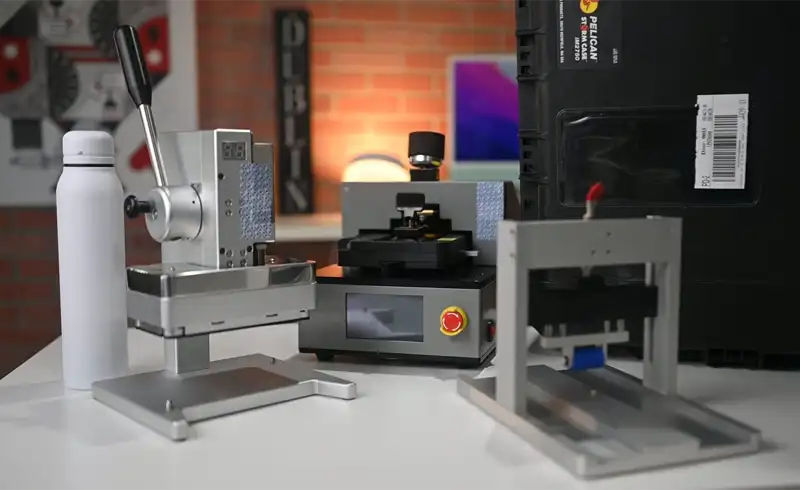
The iPhone tool kit ships in two industrial Pelican cases weighing roughly 36 kg total. It arrives by UPS, occupies a square metre of your floor, and must be returned within 7 days via the same carrier. For someone who just wants to "swap a battery" at home on a Sunday, the experience is completely incompatible with real life.
Deposit of ~$1,200 for a 7-day kit rental
Apple places a hold of roughly $1,200 on your card for the rental period. If you exceed the 7 days or lose a part from the kit, the funds are not released — they become a penalty. For a single iPhone battery swap (which costs ~80 EUR at our shop), Apple ties up a sum equivalent to a new MacBook.
Supported models — limited, delayed, never the newest
The programme started with iPhone 12 and 13, then slowly added newer models. For iPhone 17 series (launched in 2025), Self Service Repair arrived more than 6 months late. On Apple Silicon MacBooks, only specific models. On iPad — extremely limited. In practice, by the time your iPhone needs a repair, Apple's programme may still be "on the way" for your model.
The real cost, in detail
Let us actually calculate what a Self Service iPhone 15 display swap costs versus an independent shop. Here is what really goes into the Self Service invoice:
| Element | Approximate cost |
|---|---|
| Part (iPhone 15 display, real example) | $229 + VAT |
| Tool kit rental (7 days) | $49 + shipping |
| Round-trip UPS shipping | $15-30 |
| Deposit held on card (refunded if everything is OK) | ~$1,200 |
| Risk of losing the deposit (broken tool or late return) | up to $1,200 |
| Risk of breaking the iPhone during repair | $200-700 additional repair |
| Your time — learning + execution + return | 6-12 hours |
Math conclusion: even if everything goes perfectly, you spent ~$300 plus 6-12 hours of your time, at your own risk, with no warranty on the workmanship. At an independent shop like ours, an iPhone 15 display swap costs roughly 800-1500 RON inclusive of VAT, labour plus part plus 3-month warranty, in 1-3 hours while you drink a coffee. The math clearly favours the independent shop.
Parts pairing — the part that ruins everything
The most damaging element of the programme. "Parts pairing" means Apple registers in their system that a specific part serial number (display, battery, USB-C port, biometric module) is assigned to a specific device serial number. If you install on your iPhone a display taken from another iPhone (perfectly functional), the system will permanently display "Unable to verify this is a genuine Apple display" — even though it literally is.
Worse, on recent models (iPhone 14+), some features get automatically disabled: True Tone refuses to work, Face ID may require recalibration at Apple, Battery Health shows "Service" regardless of the actual battery state. For independent shops, this means we can no longer reuse parts from donor devices — even if they physically work. The waste created is enormous.
On recent models — practically impossible
For iPhone 17 series (launched in 2025) and iPad Pro M4/M5, the programme arrived with significant delay. Even now, the list of available parts is limited — laminated display, battery on certain generations, but not the logic board, not the on-board connectors, not the small components. For repairs that are truly useful (burnt USB-C port, capacitors, decorrosion after liquid), Self Service Repair has absolutely no parts.
Technical conclusion: the Apple programme covers only simple mechanical repairs (whole-part swap) and only for parts Apple chose to include in the catalogue. For any repair requiring technical expertise — and that is 80% of real problems — Self Service Repair does not exist.
What Right to Repair Europe is doing
European right-to-repair organisations (Right to Repair Europe, RREUSE, iFixit) have reacted critically to Apple's programme. Their public position: the programme does not meet Right to Repair standards because it keeps parts pairing and exclusive control over authorisation. The EU continues to press through the Ecodesign Directive (applicable from 2024-2025), and Apple has made a few concessions — but the restrictive foundation remains. Systemic change will take years.
The real alternative: a quality independent shop
For the real user who wants fast, affordable, quality repair, serious independent workshops are the working solution. What you get at a good independent shop:
- OEM or original Refurbished parts tested before installation;
- Specialist technician who has done thousands of repairs on that model;
- Written estimate before any work — you know exactly what you pay;
- Labour plus professional tools — no rental on your part;
- 3-month warranty on labour and parts;
- 1-3 hours in the shop, not 6-12 hours on your floor with borrowed tools;
- Prices 30-50% below Apple Store on most common repairs.
The only real limitation: certain functions dependent on parts pairing (perfect True Tone, full Face ID reset, biometric on Pro models) may require extra configuration. At our shop, we explain this honestly at diagnosis — you know exactly what you get before accepting the repair.
Frequently asked questions
Then why did Apple launch this programme at all?
Can I sign out of iCloud beforehand and use Self Service Repair without System Configuration?
Are there any models where the programme is actually worth it?
What real alternatives do I have to save versus Apple Store?
Will Apple Self Service Repair become more user-friendly in the future?
Sources
- Apple Newsroom — Apple launches Self Service Repair in Europe (December 2022, official launch)
- iFixit — Apple's Self-Repair Vision Is Here, and It Has a Catch
- iFixit — The End of Parts Pairing? Almost. (analysis post-2024 relaxations)
- Right to Repair Europe — Apple's self-repair programme is not the Right to Repair we need
- Self Service Repair Store (Apple official) — selfservicerepair.com